
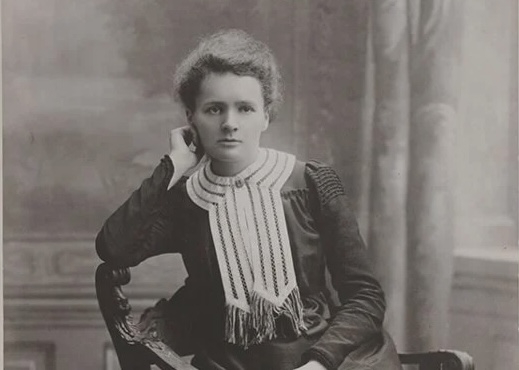
Marie Curie was a scientist whose curiosity reshaped modern medicine and physics. Born Maria Skłodowska in Poland in 1867, she grew up in a culture that did not readily open its universities to women. Determined to learn, she pursued her studies in secret before eventually moving to Paris to continue her education at the Sorbonne. There, she earned degrees in physics and mathematics and began research that would change the scientific world.
Curie’s work focused on radioactivity, a term she introduced to describe the energy emitted by certain elements. Through painstaking laboratory experiments, she discovered two new elements, polonium and radium. Her research earned her the Nobel Prize in Physics in 1903, making her the first woman to receive the honor. In 1911, she won a second Nobel Prize, this time in Chemistry, becoming the only person in history to win Nobel Prizes in two different sciences.
Her discoveries were not confined to theory. They laid the groundwork for radiation therapy in cancer treatment. During World War I, Curie helped equip mobile X-ray units that brought life-saving imaging directly to wounded soldiers.
Marie Curie’s Key Accomplishments
Marie Curie’s work reshaped science and medicine in ways that still impact the world today. Her achievements were not symbolic victories. They were measurable, groundbreaking contributions to human knowledge.
- Discovered Polonium and Radium
Through meticulous laboratory research, Curie identified two previously unknown elements, expanding the periodic table and deepening scientific understanding of atomic structure. - Coined the Term “Radioactivity”
She defined and advanced the study of radioactive elements, laying the foundation for nuclear physics and modern radiation science. - First Woman to Win a Nobel Prize
In 1903, she received the Nobel Prize in Physics, becoming the first woman ever honored with the award. - Only Person to Win Nobel Prizes in Two Sciences
She later earned the 1911 Nobel Prize in Chemistry, a distinction unmatched in scientific history. - Advanced Medical Use of Radiation
Her research paved the way for radiation therapy in cancer treatment, transforming modern medicine. - Developed Mobile X-Ray Units in World War I
Curie helped design and deploy portable radiography units that assisted doctors in treating wounded soldiers on the front lines.
Her accomplishments were not simply academic milestones. They demonstrated that persistence, intellect, and courage could expand the boundaries of what science — and women — were permitted to achieve.
Women in Science at CSM
Marie Curie’s legacy is more than scientific achievement. It is a story of perseverance, intellectual bravery, and service to humanity. At College of Saint Mary, the Marie Curie Scholars Program honors that legacy by supporting women who are ready to pursue bold questions in science and mathematics. In our all-women’s environment, students gain the confidence to lead in laboratories, classrooms, and research settings. Guided by Mercy values, they are encouraged to use knowledge not only to discover, but to serve. Like Curie, they are preparing to expand what is possible.
Image source: Marie Curie – Nobel Prize Photo gallery